



2026/27 SEASON
SSFC TEAM FORMATION INFORMATION
The SSFC TEAM PLACEMENT/ DISCOVER SESSIONS Fall 2026/ Spring 2027 Seasons were held at the Breck Kingdom Park Soccer Field.
If your player missed the sessions in early May please email Director@HighCountrySoccer.org with your player's name and 2026 Fall Grade level.
Fall 2026/ Spring 2027 Seasons:
GRADE LEVEL TEAMS FOR FALL 2026!
GIRLS:
3rd+4th Grade U10: August 1, 2016, 2017 - July 31, 2018:
5th Grade U11: August 1, 2015 - July 31, 2016:
6th Grade U12: August 1, 2014 - July 31, 2015:
7th + 8th Grade U13: August 1, 2012 - July 31, 2014:
GIRLS Fall 2026 Season only:
9th + 10th Grade U16: August 1, 2010 - 2011, plus 9th grade 2012 Girls:
11th + 12th Grade U18: August 1, 2008 - July 31, 2010
Team Placement/Discovery Session: May 20 from 5:45-7:30pm
Please register below for your players' session = Intent to Play verification
Fall 2026/ Spring 2027 Seasons:
GRADE LEVEL TEAMS FOR FALL 2026!
BOYS:
3rd + 4th Grade U10: August 1, 2016, 2017 - July 31, 2018:
5th Grade U11: August 1, 2015 - July 31, 2016:
6th Grade U12: August 1, 2014 - July 31, 2015:
7th Grade U13: August 1, 2013 - July 31, 2014:
8th Grade U14: August 1, 2012 - July 31, 2013:
BOYS Spring 2027 Season only registration will be held after the SHS Soccer season has competed:
9th Grade U15: August 1, 2011 - July 31, 2012 (plus 2012 9th graders):
10th Grade U16: August 1, 2010 - July 31, 2011:
11th/12th Grade U18: August 1, 2008 - July 31, 2010
Please register below for your players' session = Intent to Play verification

THE CORE CHANGE
Beginning with the Fall 2026 season:
· Age groups will be determined by a national School Year calendar. Birth date between August 1 - July 31.
· This replaces the previous Calendar Year system. Birth date between January 1 - December 31.
· Why? This national mandate is designed to group players with more of their school peers and improve social alignment. More rationale below.
IMMEDIATE IMPACT: WHAT STAYS THE SAME?
It is vital to note that nothing changes for the current Spring 2026 season.
· Current teams remain together through the 2026 Spring season.
· Competition schedules and training plans remain intact for the current cycle.
· No player movement will occur until the official transition period begins.
UPDATE: The 2026/27 age groups (the new U11-U17 boys and U11-U14 girls’ teams),
will train on Friday, April 3, 10 and May 1 at the Kingdom Park Soccer Field in Breck.
The U16 - 2010/11 Girls team will be invited for a team placement/ discovery session in May after their High School Soccer Season has finished.
School Year Team Training sessions for the U11-U15 teams where players practice within their 2026/27 school-year age groups.
· Purpose: To help players meet potential new teammates from within the HCSA/SSFC membership and help coaches assess the pool of players in the new age bands.
· Format: This session replaces the Friday Club training session. It is not a high-pressure tryout; it is an integration and identification opportunity.
THE TRANSITION TIMELINE
A deliberate, player-centered timeline has been created to ensure a smooth adjustment for all families.
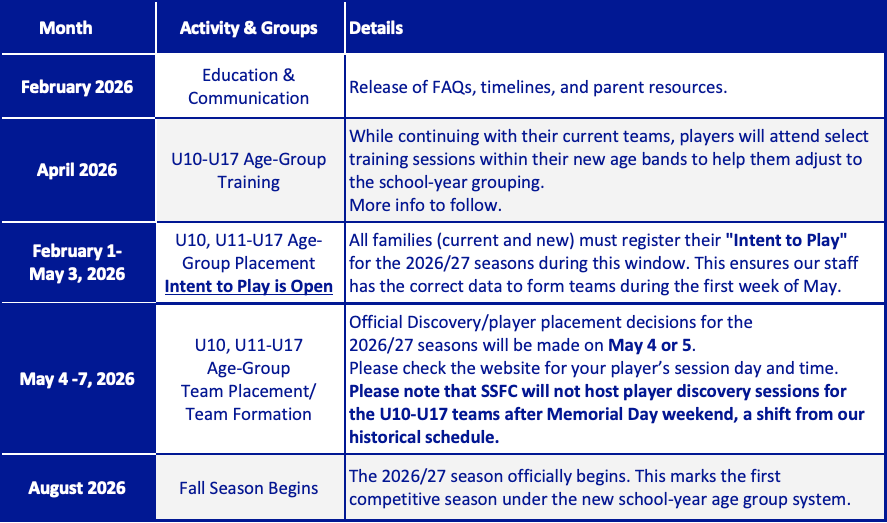
All current SSFC players are invited and expected to attend their new 2026/27 Age Group Team Training sessions if they plan to play in the 2026 Fall/2027 Spring Season.
Absences should be communicated through your team coach and SportsYou calendar rsvp tracking.
WHAT?
TRANSITIONING FROM BIRTH YEAR TO SCHOOL YEAR TEAMS
After nearly a decade of data and feedback, national associations U.S. Youth Soccer and US Club Soccer determined that the costs of the Birth Year system (social disruption, trapped players) outweighed the benefits. The decision to return to School Year (August 1-July 31) in 2026 is a move to prioritize the player experience over international administrative alignment. It restores the link between soccer teams and school grades, ensuring that no player is "trapped" alone while their teammates go to High School.
WHY?
5 POSITIVE BENEFITS WE CAN EXPECT FROM THE TRANSITIONING
The return to School-Year Age Groups is widely viewed as a "correction" that benefits the vast majority of youth players in the U.S. system. Here is a breakdown of why this change is a positive step for player development and family experience.
1. Social & Emotional Alignment: It better aligns players with social connections through school.
· The Benefit: In the U.S., a child’s social life typically revolves around their grade in school. The previous birth-year system split friends by an arbitrary January 1st cutoff.
· Why it Matters: Especially at the recreational level, when players are on teams with their classmates, they feel a stronger sense of belonging. This social comfort leads to better retention (kids don't quit) and better team chemistry on the field. It simplifies life for parents, too, as school carpools and school schedules align more naturally.
3. A Later Entry into Advanced Pathways: It reduces the rush into competitive environments early.
· The Benefit: The shift to school-year age groups effectively lowers the average chronological age of a team by approximately six months. This structural change naturally "taps the brakes" on the youth soccer timeline, keeping the focus on development rather than destination.
· Why it Matters: By slightly lowering the age profile of each group, we gain a valuable window to keep players engaged in local, socially driven environments for longer. This delays the onset of travel and higher financial commitments, allowing kids to prioritize fun and friendships. We know that extending this younger age "social play" phase is statistically one of the best ways to ensure happier players who stay in the game for the long haul.
2. Better Development for Younger Players: It keeps kids playing small-sided games longer.
· The Benefit: By shifting the calendar down, the "average" age of a team drops slightly (by about 6 months). This means players spend a bit more time in developmentally appropriate formats (4v4, 7v7, 9v9) before rushing to the full-sized 11v11 field.
· Why it matters: Small-sided games are critical for skill acquisition. Players get more touches on the ball and have to make quicker decisions. Extending this phase—rather than rushing onto a massive field where athleticism dominates skill—is better for long-term technical growth.
4. Solving the Trapped Player Problem: It removes the secondary season issue for U15 players.
· The Benefit: This is arguably the most critical logistical fix. In the birth-year system, a U15 team was often a mix of 8th graders and 9th graders. The 9th graders left to play High School soccer, leaving the 8th graders "trapped" without a full team or a league to play in.
· Why it Matters: The school-year system keeps the entire team together. 8th graders will typically play with 8th graders; 9th graders will typically play with 9th graders. The team stays intact, training continues uninterrupted, and 8th-grade families aren't forced to scramble for "orphan" teams.
5. A Complete U19 Season: It fulfills the U18/U19 year with the same players.
· The Benefit: Previously, the oldest age group (U19) was often decimated because the oldest birth-year players had already graduated high school and left for college, leaving the remaining high school seniors with a depleted roster. SSFC is building towards a U19 age group in the spring of 2027 by collaborating with the SHS soccer coaching staff.
·
Why it Matters: By aligning with the school year, the "U19" season matches the Senior Year of high school for most players. The team stays together for one final, cohesive season (often a critical recruiting year) before everyone graduates at the same time.
PHILOSOPHY BY PROGRAM: HOW WE APPROACH TRANSITION
SSFC U10 PROGRAM 2026/27
Philosophy: The Developmental Bridge. The U10 Program serves as the bridge between the fun-first focus of the HCSA Recreational Leagues and the development-first focus of the SSFC. Players (boys and girls) born after August 1, 2017, and in 2018 will make up the 2026/27 group. Exceptions may be made for players born during January through April 2019, if they are ready (relating to both their soccer skills and emotional maturity) to be included.
Competitive SSFC U11-U19
· Philosophy: Optimal Environment. In SSFC, our priority is long-term player development. Our goal is to place every player in a competitive setting where they can grow the most. We aim to find the right balance where a player is challenged enough to improve yet confident enough to take risks, avoiding both the stagnation of being too comfortable and the frustration of being overwhelmed.
· Our Approach to the Transition: We are approaching this change with the goal of building more cohesive and stronger teams. By aligning with the school year, we establish a clear competitive pathway that supports both confidence and long-term ambition. We are dedicated to placing your child in a role where they can truly contribute, compete, and thrive alongside their peers.
AGE GROUP CHANGES: COMPREHENSIVE FAQ
What exactly is changing? Starting in the Fall 2026 season, youth soccer age groups will be determined by a national School Year calendar (August 1-July 31). This replaces the current Birth Year Calendar Year system (January 1-December 31).
Is this decision unique to SSFC? No. This is a nationwide mandate adopted by Colorado Soccer Association, U.S. Youth Soccer (USYS), US Club Soccer, and AYSO. SSFC is aligning with these national standards, just like other clubs in the state and across the country.
Why is this change happening? The national governing bodies identified three main benefits:
1. School Alignment: More players will now play with their classmates and grade-level peers than in the previous system, improving social cohesion.
2. Reducing the "Trapped Player" Issue: The new calendar significantly reduces the number of 8th graders left behind without a team when their older teammates move to High School soccer.
3. Clearer Long-Term Pathways: Aligning age groups with graduating classes simplifies the college recruiting process, making it easier for scouts to evaluate players within their true academic peer group.
When does this officially start? The new age groups go into effect for the 2026/27 season (starting August 2026). The current age groups/ teams for the Spring 2026 season remain unchanged.
My child was born between August 1 and December 31. What does this mean for them? Under the old system, these players were the youngest in their age group. Under the new School Year system, they will become the oldest in their age group. This often provides a leadership opportunity and a confidence boost.
My child was born between May 1 and July 31. What does this mean for them? Under the new system, these players shift from the middle to the youngest in their age group. While initially challenging, John O'Sullivan (Changing the Game Project) calls this the "Underdog Advantage." Because these players cannot rely on physical size to win, they are forced to develop superior technique, faster decision-making, and "grit" to compete. Long-term data shows that "youngers" who stick with it often surpass their older peers because they develop a higher Soccer IQ and cleaner skills out of necessity.
Will players be organized strictly by their school grade? No. Players will be organized by "School-Year Age Groups" (August 1-July 31), not by their specific academic grade.
Here is the difference: While the new system will naturally align most players with their classmates, "Grade Level" is an academic designation that varies from family to family (due to children starting school early or late, repeating a year, or varying state enrollment dates).
"School-Year Age Groups" use a strict national birthdate range (August 1 to July 31). This ensures a nationwide consistent, fair, and objective standard for safety and competition, regardless of a player’s individual academic path.
Why are teams organized by the August 1–July 31 date range rather than strictly by "Grade Level"? While the new age group system is often referred to as "School Year" because it aligns better with school grades in the majority of the States than the calendar year, we will use the nationwide age groupings of August 1st to July 31st date range for safety and fairness.
We cannot organize strictly by "Grade" because grade levels are variable, whereas birth dates are factual. Organizing strictly by grade can create significant risks:
· The Age Gap Risk: Because kids start school at different ages, are held back, or skip grades, a single grade level can include children whose ages span 2+ years.
· Physical Safety: We already see significant physical differences within a standard 12-month age gap. If we were to widen that window to 24+ months (as seen in strict grade-based grouping), the physical disparity becomes dangerous. A "held-back" 13-year-old competing against a young 11-year-old in the same grade poses a real safety concern.
· Developmental Fairness: When age gaps widen beyond 12 months, the disparity in talent and physical maturity widens considerably. Keeping the grouping within the August 1–July 31 window ensures players compete with and against peers of similar physiological, emotional, and social maturity.
What if my soccer age group is different from my actual school grade?
You will generally be placed in the age group determined by your birth date (August 1-July 31), but there is flexibility depending on your program level.
· The Rule: We use the August 1-July 31 birth date ranges to form teams. This ensures fair competition and aligns with the new national standards.
· The Exception (Playing Up): If a player is "young for their grade" (e.g., they are in 8th grade, but their birth date places them in the 7th-grade soccer group), they may be allowed to play up to stay with their classmates, provided they are developmentally ready.
· Playing Down: Consistent with national rules, playing down at the Competitive level (playing in a younger age group than your birth date allows) is generally not permitted, even if a player is in a lower grade at school.
Why was August 1st to July 31st selected as the age range? We know that Colorado schools typically follow an October 1st cutoff. However, after a detailed analysis by youth soccer governing bodies across the nation, the August 1st to July 31st range was selected because it captures the most players in the same grade nationwide. This ensures consistency for tournaments and leagues.
Will my child repeat an age group? For players born between August 1st to December 31st, they will generally repeat the same age group in 2026/27 that they did in 2025/26, unless they play up into an older age group.
Do large age group changes like this happen often? No. This change is a rare, structural shift designed to benefit the majority of players throughout the remainder of their youth soccer journey. We don't anticipate your child experiencing any additional age-group changes during their time in youth soccer.
SSFC U10-U19 TEAMS/ROSTERS
Will my child’s current team be broken up? Some teams may remain largely intact if the majority of players share the same school year age group. However, some rosters will see changes. Our priority is not just "keeping a team together," but placing individual players in the environment where they will thrive socially and competitively.
Can't we just "grandfather" our SSFC team so it stays together? Unfortunately, no. Because our teams compete in the Colorado State league (CSA), we must strictly adhere to the roster rules of those governing bodies. If we kept a roster "as is" based on birth year, we would be ineligible to compete against clubs following the new School Year mandate.
Can my child "play up" to stay with their current team? "Playing up" is permitted in specific cases based on developmental readiness and coaching staff evaluation. However, it is not the default solution for keeping a roster together. Decisions are made player by player, not team by team.
Can my child "play down" to stay with friends? Generally, no. Colorado Soccer Association, and USYS rules are strict regarding playing down in age groups. Players must compete in their age-appropriate group (or a higher group), unless there are rare medical or specific organizational exceptions that require approval at the league level.
Who will be my child’s coach? Coaching assignments are determined by the Executive Director and Director of Coaching to ensure the best fit for each team's developmental level. The specific coaching slate for the 2026/27 seasons will be announced prior to player team placements in May 2026.
What is "School Year Team Training"? Beginning on April 3, SSFC will introduce training sessions for the U11-U15 teams where players practice within their new school-year age groups.
· Purpose: To help players meet potential new teammates from within the HCSA/SSFC membership and help coaches assess the pool of players in the new age bands.
· Format: This session replaces the Friday Club training session. It is not a high-pressure tryout; it is an integration and identification opportunity.
· The 2026/27 age groups (the new U11-U17 boys and U11-U14 girls’ teams), will train on Friday, April 3, 10 and May 1 depending on the weather/ field conditions.
· The U16 - 2010/11 Girls team will be invited for a team placement/ discovery session in May after their High School Soccer Season has finished.
It is expected that all players will attend their new 2026/27 Age Group Training sessions, which will be added in the calendar on SportsYou. Absences should be communicated through your team coach and SportsYou rsvp tracking.
Will the April 3, 10 and May 1 age group trainings be just for training, or are players being evaluated? Both. At SSFC, internal player evaluations are a year-round process, but these specific sessions allow us to better understand how players fit within their new, broader peer groups, a necessity especially this year. While these sessions provide us with important insight, formal team placement/discovery sessions will still be held in May, aligning with the official tryout window for the Colorado Soccer Association.
Please make the coaching staff aware
prior to May 1,
if your player would like to be considered for a higher age group.
